
Schools bring together large numbers of students and staff in buildings that include kitchens, cafeterias, storage rooms, washrooms, and outdoor grounds, all in daily use. That combination of food, water, waste, and constant activity creates conditions pests can exploit, often well before anyone notices a problem. In Abu Dhabi, the hot climate and irrigated landscaping common on many campuses add another layer to this, since outdoor moisture and greenery can support pest activity that eventually reaches the building itself.
A single pest sighting rarely tells the whole story. It’s usually a sign of an underlying condition (a gap in a wall, a moisture source, a food-storage practice) that needs to be identified rather than just sprayed away. Regular pest management, built around inspection and prevention rather than reacting to what’s already visible, tends to catch these problems while they’re still small.
Schools looking for a structured, school-specific pest management programme can learn more about our school pest control services in Abu Dhabi.
Schools Have Multiple Conditions That Attract Pests
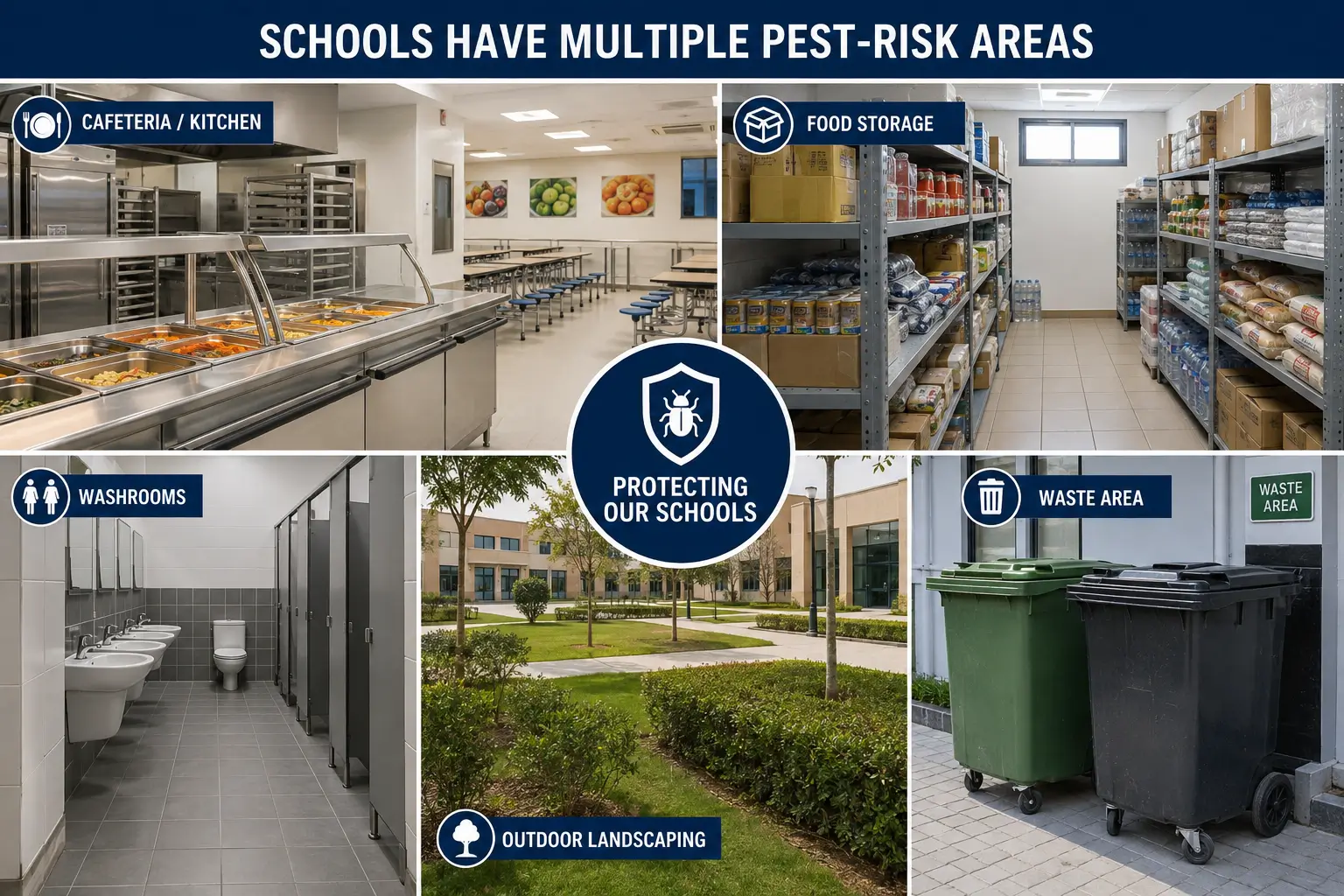
A campus offers pests several things they need to survive: food, moisture, shelter, and access points. These conditions show up in predictable places:
- Food residue and crumbs in classrooms and common areas
- Kitchens and cafeterias where food is prepared and served
- Food-storage rooms, particularly where packaging isn’t fully sealed
- Waste bins and collection areas
- Moisture around drains, washrooms, and irrigation systems
- Landscaping and garden beds close to buildings
- Gaps around doors, vents, and utility penetrations
- Storage rooms that go unused for long stretches
None of these guarantee a pest problem on their own, but together across a large campus they add up to considerably more opportunity than a typical office or home.
Regular Pest Control Helps Protect Students and Staff
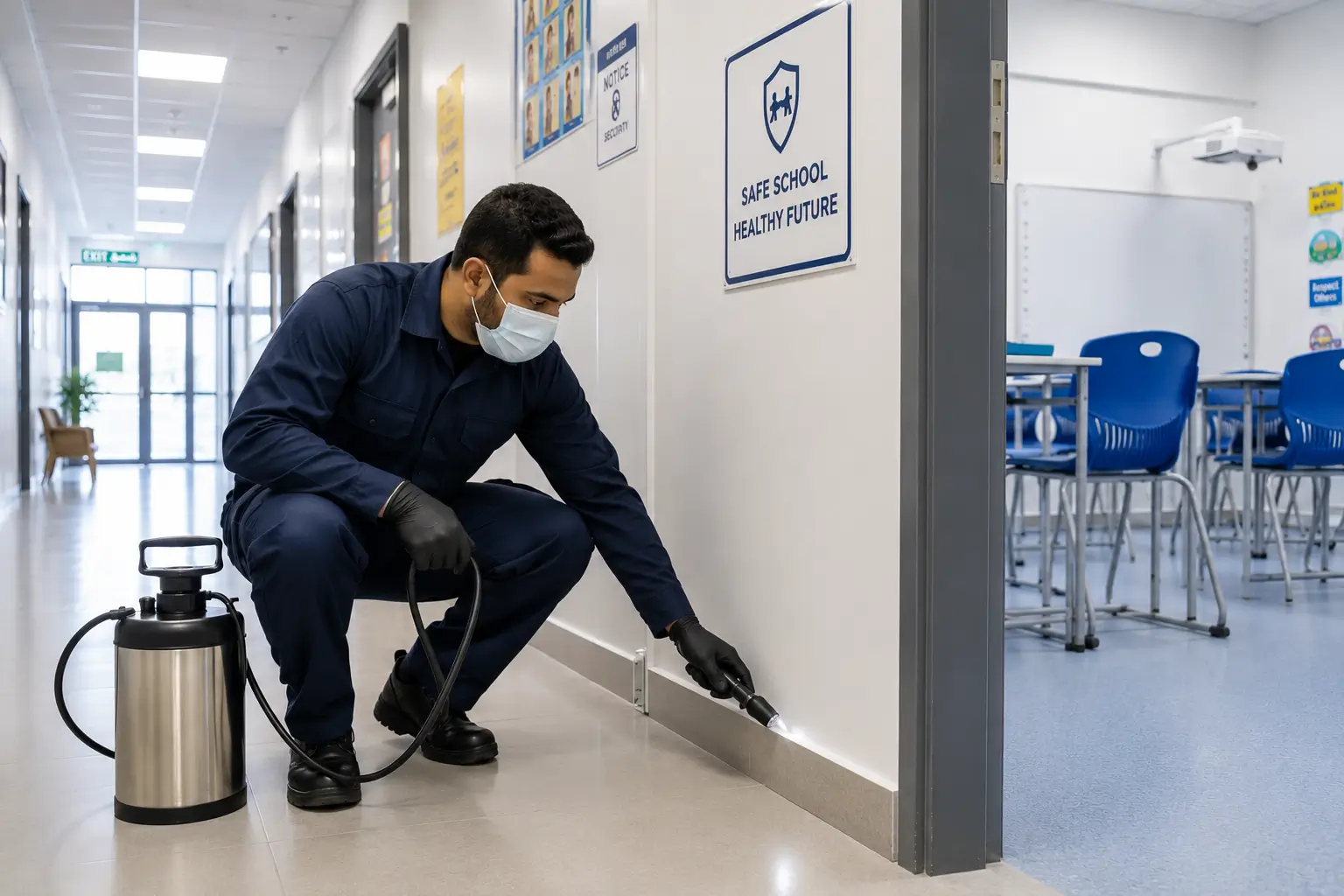
The goal of school pest management isn’t just to remove pests when they’re seen. It’s to reduce unnecessary contact between people and pest activity in the first place. That means keeping food-handling areas, classrooms, and common spaces free of the conditions that let pests establish themselves, and addressing activity before it spreads to areas students and staff use every day. Responsible pest control achieves this through targeted treatment, appropriate scheduling, and monitoring, not through blanket claims that a service is “100% safe” or eliminates all risk. Any provider working in a school should be able to explain what was done, where, and why, rather than relying on marketing language in place of specifics.
Pest Infestations Can Spread Quickly in Schools
Schools are more vulnerable to fast-spreading pest activity than many other property types, simply because of scale: large numbers of people, shared facilities, and multiple connected rooms or buildings under one roof.
A cockroach population that starts in a kitchen can move along plumbing lines into adjacent rooms. Ants that find a food source in one classroom can establish trails extending through corridors. Flies breeding in a poorly maintained drain aren’t confined to that one spot; they move throughout a building. Rodents, similarly, don’t stay put once they’ve found an entry point; they follow wall cavities and service ducts between rooms.
This connected nature is exactly why addressing a pest sighting in isolation often isn’t enough. The areas around it usually need checking too.
Regular Inspections Help Detect Pest Problems Early
There’s a meaningful difference between reactive pest control (calling someone only after a pest is seen) and preventive pest management, which involves scheduled inspection regardless of whether anything has been reported.
Early signs a trained inspector looks for include:
- Droppings or evidence of nesting
- Gnaw marks or physical damage
- Shed skins or egg cases
- Activity in typically hidden areas, such as behind equipment or inside voids
- Entry points along walls, doors, or utility lines
- Moisture problems that could support breeding
Catching these signs during a routine inspection, rather than waiting for a visible infestation, is generally far less disruptive to resolve.
Regular Pest Management Protects School Kitchens and Food Areas
School kitchens and cafeterias are usually the highest-priority areas on any campus, because food, water, and warmth are all present together. Cockroaches and flies are drawn to food residue and organic waste; rodents and ants are drawn to accessible food storage; drains can support fly breeding if not properly maintained.
Pest control in these areas works alongside good sanitation and food-storage practices, not instead of them. Sealed containers, clean equipment, well-maintained drains, and timely waste removal all reduce the conditions pests need, while inspection and targeted treatment address anything that gets through despite those practices.
Pest Control Helps Prevent Property Damage
Some pests pose a risk to the building itself rather than to hygiene. Termites, for example, are relevant wherever wooden fixtures, furniture, doors, or structural wood elements are present, and rodents can damage stored materials or fixtures while searching for nesting material.
This risk isn’t universal to every school. It depends on construction materials, building age, and surrounding landscaping, but where wood-contact points exist, periodic inspection is a reasonable precaution rather than an assumption that damage is already occurring.
Regular Pest Control Supports School Hygiene and Facility Management
Pest management works best as one part of a broader facilities routine, alongside cleaning schedules, waste management, drain maintenance, and food hygiene practices. It isn’t a substitute for any of these; a school with poor sanitation practices will continue to attract pests regardless of how often a technician visits.
What pest control adds is inspection, identification, and documentation that feed back into the school’s own facility management: flagging a moisture issue near a washroom, or a gap around a delivery door, that maintenance staff can then address directly.
Schools Need More Than Occasional Pest Spraying
A single spray treatment addresses visible activity at that moment, but it doesn’t address why the activity was there in the first place. This is the reasoning behind Integrated Pest Management (IPM), a recommended approach to institutional pest management that most pest management bodies and standards point to for facilities like schools.
IPM follows a structured sequence:
Inspection → Identification → Prevention → Monitoring → Targeted Treatment → Follow-Up
Inspection identifies where activity or conducive conditions exist. Identification confirms which pest is involved and how significant the activity is. Prevention recommendations, such as sealing gaps or making sanitation changes, reduce the underlying conditions. Monitoring tracks activity over time. Targeted treatment is applied only where it’s needed, based on the pest and location. Follow-up confirms whether the approach worked or needs adjusting.
This is a materially different approach from an occasional spray visit, and it’s the standard schools should look for in a provider handling an institutional property.
How Often Should Schools Have Pest Control?
There isn’t one universal frequency that applies to every school. How often a campus needs inspection and service depends on:
- The size of the school and number of buildings
- Previous pest activity or history of infestations
- Whether the school operates a full kitchen and cafeteria
- Building age, design, and construction materials
- Surrounding landscaping and environment
- Seasonal pest pressure, which in Abu Dhabi can shift with the cooler winter months versus peak summer heat
- Findings from previous inspections
A professional provider should be able to recommend a schedule based on these factors after an initial inspection, rather than applying a fixed interval to every site regardless of risk.
Areas That Should Be Included in School Pest Inspections
A thorough inspection covers considerably more than the areas where pests have actually been seen:
- Classrooms
- Kitchens and cafeterias
- Food-storage rooms
- Washrooms and drains
- Storage rooms
- Waste collection areas
- Playgrounds
- Gardens and landscaping
- Building perimeter
- Utility and service areas
Skipping any of these during an inspection risks missing a condition that could support pest activity elsewhere on the campus.
Signs a School May Need Pest Control
Facility staff are often the first to notice early warning signs, even before a formal inspection is due:
- Pests seen during the day, which for some species can suggest a larger hidden population, though this depends heavily on the species and circumstances involved
- Droppings in kitchens, storage rooms, or along walls
- Shed skins or egg cases
- Unusual or musty odours
- Gnaw marks on packaging, wiring, or fixtures
- Damaged food packaging
- Visible ant trails
- Increased fly activity around waste or drains
- Signs consistent with termite damage
- Pest sightings that keep recurring despite regular cleaning
Any of these are reasonable grounds to request an inspection rather than waiting for the next scheduled visit.
Also read > Common Diseases Caused by Pests in Dubai and Abu Dhabi & How to control them
Why Professional Pest Control Is Better Than Waiting for an Infestation
Professional pest control offers several things occasional DIY measures generally can’t: accurate identification of the species involved, treatment methods matched to the specific pest and location, monitoring that confirms whether the problem is actually resolving, and documented findings the school can reference later.
Good housekeeping is still a genuine part of pest prevention. But identifying the underlying cause of recurring activity, and treating it appropriately for a facility with children present, is generally better handled by a provider trained specifically for institutional and school environments.
Choosing a Pest Control Company for a School
Not every pest control provider is set up to handle institutional properties like schools. When evaluating a provider, it’s worth checking for:
- Appropriate licensing for commercial and institutional pest control
- Experience specifically with schools or similar facilities
- School-appropriate safety procedures, including scheduling around occupancy
- An inspection-led approach rather than treatment-only visits
- Use of Integrated Pest Management principles
- Clear documentation after each visit
- Flexible scheduling around school hours and events
- Follow-up service built into the process, not treated as an afterthought
Frequently Asked Questions
How often should schools have pest control?
This depends on the school’s size, pest history, kitchen operations, and surrounding environment. Rather than a fixed schedule, frequency is best set after an initial inspection assesses the specific risk factors at that campus.
Why is pest prevention important in schools?
Prevention addresses the conditions that allow pests to establish themselves (food access, moisture, entry points) rather than only responding once activity is visible. This generally means fewer disruptions and less risk of activity spreading between connected areas.
What pests are commonly found in schools?
Cockroaches, ants, flies, and rodents are most often associated with food-handling and waste areas, while mosquitoes are more relevant to outdoor spaces with standing water. Termites and bed bugs are less common but relevant in specific circumstances, such as wood-heavy structures or boarding facilities.
Is regular pest control safe for schools?
Pest control carried out by trained technicians following product label instructions is designed to minimize risk, but no treatment can be described as entirely risk-free. Responsible providers reduce exposure through targeted application, appropriate scheduling, and clear communication with school staff.
Can pest control be done during school holidays?
Yes, holidays and low-occupancy periods are often used for more involved treatment work, while routine inspection and monitoring can typically be scheduled with minimal disruption during term time.
What areas of a school should be inspected?
Classrooms, kitchens, cafeterias, food storage, washrooms, drains, storage rooms, waste areas, playgrounds, gardens, the building perimeter, and utility spaces should all be part of a thorough inspection, not just the area where a pest was last seen.
What is integrated pest management in schools?
IPM is a structured approach combining inspection, identification, prevention, monitoring, targeted treatment, and follow-up, rather than relying on treatment alone. It’s designed to address the underlying causes of pest activity, not just the pests currently visible.
What should a school do after finding a cockroach or rodent?
Note where and when the sighting occurred, and contact a pest control provider rather than waiting for the next scheduled visit, particularly if the sighting was in or near a food-handling area.