
Bee & Wasp Removal in Abu Dhabi
Safe, same-day bee hive and wasp nest removal across Abu Dhabi. Our Tadweer-licensed technicians remove nests from villas, apartments, warehouses, schools, and commercial properties. Whenever it’s safe, we relocate honey bee colonies instead of destroying them.
Tadweer Licensed
24/7 Emergency Service
Safe for Kids
& Pets
Long Lasting Results with Warranty
MOCCAE-Approved Products
Explore Our Services


Book Bee & Wasp control in Abu Dhabi today
24/7 Every Day
Office 3, 2nd Floor, Plot 7, Musaffah 10 (M10), Abu Dhabi
info@bitepestcontrol.com
Why Most People Don't Notice a Bee Problem Until It's Too Late
Most bee problems in Abu Dhabi start with just a few bees flying around the same roof corner, split AC unit, wall vent, or palm tree. Because the activity looks harmless, many homeowners think the bees will leave on their own. In reality, they may already be building a colony inside a hidden wall or roof cavity.
This is especially common in villa communities like Khalifa City, Al Reef, Mohammed Bin Zayed City, and Al Shamkha, where landscaped gardens, palm trees, and constant irrigation create ideal conditions for swarming bees.
By the time you hear buzzing indoors or notice bees using the same entry point every day, the colony is usually well established. At that stage, simply spraying the entrance rarely works. The comb and honey remain hidden inside the cavity, which is why complete removal, cleaning, and sealing are needed to stop the problem from returning.
Bee Season in Abu Dhabi
Bee and wasp activity here follows the weather closely, and knowing the pattern helps you act at the right time.
Spring, roughly February to May
It is the busiest period by a wide margin. Temperatures are comfortable, desert and garden plants are flowering, and colonies are strong enough to split. Almost all of our swarm calls land in this window. If you are going to inspect your roof and seal gaps, do it in January before this starts.
Early summer, May to June
It brings a change in the calls. Swarming slows down, but colonies that moved in during spring are now large and established. This is when people start hearing buzzing indoors and seeing stains, because the comb has had time to fill with honey.
Peak summer
It pushes both bees and wasps toward water. Extreme heat means they cluster around irrigation lines, AC drip points, pool edges and taps. Sting incidents around gardens and pools go up even though nesting slows.
Autumn and winter
These are quieter, and this is the best time for preventive work. Colonies are less defensive, and sealing entry points now means fewer problems when spring returns.
Signs You Need Professional Bee or Wasp Removal in Abu Dhabi
Bees using the same entry point every day
Steady bee activity through the same hole usually means there is a hive hidden inside a wall, roof, or ceiling. The colony will continue to grow unless it is professionally removed.
Buzzing inside walls or ceilings
If you can hear buzzing indoors, the hive is likely inside the structure of your property. Hidden colonies require proper removal to prevent further damage.
Honey stains on ceilings or walls
Dark stains or sticky patches often mean honey is leaking from a hidden hive. This can damage plaster, attract ants and other pests, and usually gets worse over time.
Wasps gathering around one area
If wasps keep circling the same doorway, balcony, roof edge, or bin area, there is likely a nest nearby that should be removed before it grows larger.
Repeated stings on your property
More than one sting in the same area usually indicates an active bee or wasp nest close by. This increases the risk to children, pets, and visitors.
A nest larger than your fist
Large nests contain more bees or wasps and are more defensive when disturbed. They should always be removed by trained professionals.
Bee & Wasp Nests We Remove in Abu Dhabi
Bee Hives
After years of removing bee colonies across Abu Dhabi, one thing becomes clear: bees rarely choose a nesting spot by accident. They look for places that are shaded, protected from wind, close to water, and disturbed as little as possible. That is why we keep finding hives in the same locations across villas, apartment buildings, and commercial properties.
Split AC housings are the most common nesting spot we see in Abu Dhabi villas. They provide shade throughout the day, a small protected entrance, and a steady source of water from the condensate drain. Because the comb is usually built behind the unit, proper removal often requires opening the housing and clearing the entire cavity before the AC can be serviced safely.
Palm trees are another favourite. The dense crown protects the colony from direct sun and human activity, while the height allows the hive to grow unnoticed for months. These jobs often require specialist access equipment to reach the nest safely.
Roof voids, parapets, and false ceilings offer quiet, enclosed spaces where colonies can expand without disturbance. Homeowners usually discover these hives only after hearing buzzing indoors or noticing honey stains appearing on the ceiling.
Wall cavities, water tank surrounds, and service areas provide warm, sheltered spaces with small entry points around pipework, vents, or expansion joints. Because the nest is hidden inside the structure, complete comb extraction is essential to prevent honey damage and future swarms.
We also remove bee colonies from garden sheds, balconies, gate posts, boundary walls, warehouses, and industrial buildings throughout Abu Dhabi.
Exposed vs Hidden Hives
Not every bee removal job is the same.
An exposed hive, such as one hanging from a tree branch or roof edge, can often be relocated by carefully transferring the colony into a hive box. These jobs are usually completed within a few hours.
A hidden hive inside a wall, ceiling, or roof cavity requires a much more detailed process. The entry hole used by the bees is often several feet away from the comb itself, so the colony must first be located before the cavity is opened. We then remove every section of comb, clean away the honey residue, treat the area to remove lingering scents, and seal the entry point. Skipping any of these steps often leads to honey leaks, pests, and another swarm returning to the same location.
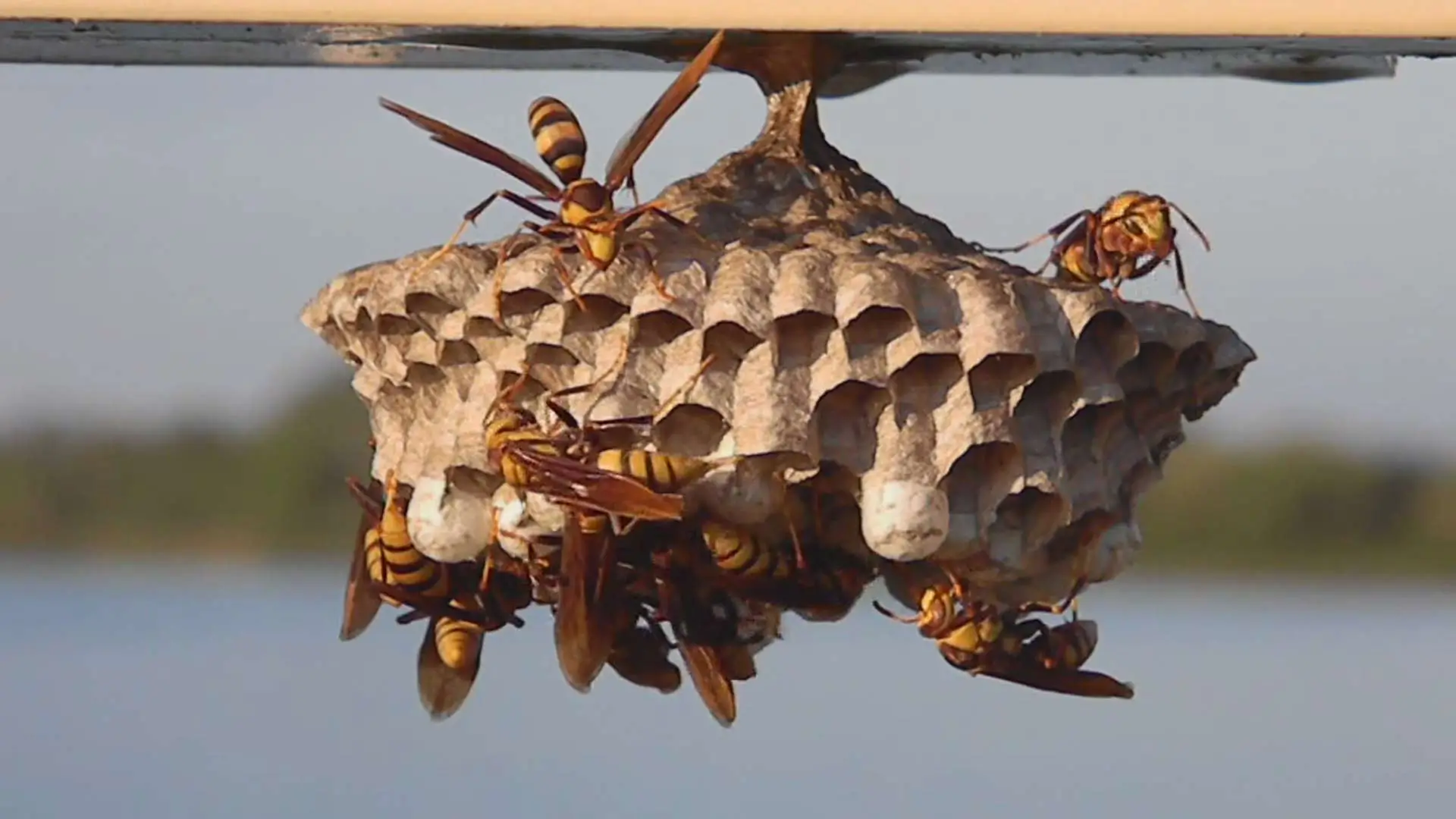
Wasp Nests
Unlike honey bees, wasps cannot be relocated. Once a nest is established, the safest solution is complete treatment and removal.
In Abu Dhabi, we commonly remove wasp nests from roof eaves, window frames, balconies, outdoor furniture, satellite dishes, drain pipes, gate posts, and bin storage areas. These sheltered locations protect the nest from heat and wind while keeping it close to food sources.
Timing makes a significant difference. A nest discovered during early spring may contain only a queen and a handful of workers, making removal quick and straightforward. By mid-summer, that same nest can grow into a colony with hundreds of aggressive wasps, increasing both the difficulty and the safety risk.
Hornet Nests
Hornets are the most aggressive stinging insects we deal with. Their colonies react quickly to disturbance, and multiple hornets can attack at the same time if the nest is threatened.
If you discover a hornet nest, keep children and pets away from the area and avoid spraying, blocking, or knocking down the nest yourself. Professional removal with the correct protective equipment is the safest way to deal with the problem.
Can Bees Damage Your House?
Yes. While honey bees do not damage concrete or brick, they often build hives inside roof voids, wall cavities, and around AC units. If the hive is left untreated, honey and wax can leak into ceilings and walls, causing stains, unpleasant odours, and attracting ants and other pests.
That is why professional bee removal includes removing the bees, the comb, and the honey residue—not just treating the entrance.
Will Bees Go Away on Their Own?
Sometimes, but only if they are a swarm. A swarm is a temporary cluster of bees resting while they search for a new nesting site. These usually move on within a day or two.
However, an established hive will not leave on its own. If you see bees repeatedly flying in and out of the same hole in a wall, roof, or AC unit, they have already built a hive. Waiting will only allow the colony to grow and increase the risk of honey damage and costly repairs.
If you’re unsure whether it’s a swarm or a hive, a professional inspection can quickly confirm it.
Bee or Wasp? How to Tell the Difference
Knowing whether you’re dealing with bees or wasps is important because they require completely different removal methods. Honey bees can often be safely relocated, while wasp nests must usually be treated and removed. Identifying the insect correctly helps ensure the safest and most effective solution.
| Feature | Honey Bee | Wasp |
|---|---|---|
| Body | Round, hairy | Slim, smooth |
| Colour | Golden brown | Yellow & black |
| Sting | Usually once | Can sting repeatedly |
| Nest | Hidden wax hive | Visible paper nest |
| Attracted to | Flowers & water | Food, sweets & bins |
| Can be relocated? | Often yes | No |
Should You Kill a Wasp Nest Yourself?
No. Disturbing a wasp nest can trigger an aggressive attack, and DIY sprays rarely eliminate the entire colony. For your safety, it is best to have the nest professionally removed, especially if it is near your home, workplace, or a high-traffic area.
Why We Relocate Honey Bees Whenever Possible
We always prefer to relocate honey bees whenever it is safe to do so. Honey bees are important pollinators, and healthy colonies can often be moved instead of destroyed.
If the hive cannot be safely relocated because of its location or the risk to people, we use the safest removal method available. In every case, we remove the comb, clean the area, and seal entry points to prevent the problem from returning.
Our Bee & Wasp Removal Process
1. Inspection & Identification
We inspect the property to locate the hive or nest and identify whether you’re dealing with honey bees or wasps. This allows us to choose the safest and most effective removal method.
2. Quote & Safety Assessment
Our technician checks the nest location, access requirements, and any safety risks before providing a fixed, upfront quote with no hidden charges.
3. Safe Removal or Relocation
Whenever possible, honey bee colonies are safely relocated. If relocation isn’t an option, or if it’s a wasp nest, we use the appropriate treatment and remove the nest safely.
4. Hive & Comb Removal
For hidden hives, we remove the bees, wax comb, and honey residue to help prevent stains, odours, and future pest problems.
5. Entry Point Sealing
We seal the gaps or openings that allowed the bees or wasps to enter, reducing the chance of another colony nesting in the same location.
Areas We Serve Across Abu Dhabi
We provide bee, wasp, and hornet removal services across Abu Dhabi, including residential communities, commercial properties, warehouses, schools, and government facilities.
Villa communities such as Khalifa City, Al Reef, Al Shamkha, Al Falah, Mohammed Bin Zayed City, Al Ain, and Al Raha see the highest number of bee swarm calls. Landscaped gardens, palm trees, and irrigated outdoor spaces make these areas attractive to honey bees searching for a new nesting site.
Industrial areas like Baniyas, Mussafah and Al Wathba generate more wasp and hornet removals, as warehouse roofs, loading bays, and steel structures provide ideal nesting locations.
For Abu Dhabi Island, Yas Island, Saadiyat Island, Al Reem, Al Shahama, Al Bahia, and Baniyas, we regularly remove hives and nests from apartment balconies, rooftops, plant rooms, and AC service areas.
Why Choose American Bite Pest Control?
People do not call a second time unless the first visit worked. Here is what keeps customers coming back to American Bite Pest Control for the bee removal Abu Dhabi has to offer:
Licensed & Compliant
Tadweer-licensed technicians using MOCCAE-approved products under ADQCC-certified supervision.
Live Bee Relocation
Whenever it is safe and practical, we relocate honey bee colonies instead of destroying them.
Complete Hive Removal
We remove the bees, comb, and honey residue, then seal entry points to help prevent future infestations.
Experienced Local Team
Trusted by homeowners, businesses, and facility managers across Abu Dhabi for safe bee, wasp, and hornet removal.
Transparent Pricing
Free inspection, fixed upfront quotes, and no hidden charges.
Frequently Asked Questions
How long does removal take?
A wasp nest usually takes 30 to 60 minutes. An exposed bee hive takes one to two hours. A hive inside a wall or false ceiling takes three to five hours, because the cavity has to be opened, cleared of comb, cleaned and closed again.
How long does live relocation take?
Collecting a settled swarm takes under an hour. Relocating an established colony from a cavity takes longer, because the comb has to be cut out and fixed into frames so the colony survives the move. Expect two to four hours.
Can you remove bees from inside a wall or roof?
Yes, and it is a large part of what we do. We locate the comb first, since the entry hole is often well away from the nest itself. Treating a wall hive without removing the comb does not work and causes honey staining later.
What should I do if someone here is allergic to stings?
Tell us when you call and we will treat it as an emergency. Keep that person indoors and away from the area. If anyone stung develops facial or throat swelling, breathing difficulty or dizziness, call 998 for an ambulance immediately — do not wait to see if it improves.
What time of day do you work?
Early morning and evening are best, because nearly all of the colony is inside the nest and activity is lower, which makes the job safer and more complete. We handle daytime and emergency calls whenever they are needed.
Do you work with businesses?
Yes. Restaurants, hotels, schools, nurseries, warehouses, labour accommodation, malls and facility management companies across Abu Dhabi. We can work outside operating hours and provide the documentation you need for inspections and audits.
If you have seen bees using the same gap for more than a couple of days, or you have found a nest anywhere near a door, a garden or a play area, it is worth getting it looked at now rather than in a month.
Send a photo on WhatsApp and we will identify it and give you a price range before we visit. The inspection itself is free, and nothing gets charged until you have agreed a fixed quote.