
Seeing a cockroach in your Al Reem Island apartment does not automatically tell you how serious the problem is. The more useful question is whether you are seeing repeated activity, signs of an established infestation, or a problem that keeps returning despite basic prevention efforts.
Al Reem Island is a waterfront Abu Dhabi community with many high-rise residential complexes. That apartment setting matters because cockroach management in multi-unit housing may require more than treating one visible location.
If you are unsure whether professional help is warranted, start with the signs below.
Signs Your Cockroach Problem May Need Professional Attention
There is no reliable universal rule such as “one cockroach always means an infestation.” Instead, look at the pattern and evidence of activity.
Signs worth taking seriously include:
- Cockroaches appearing repeatedly
- Activity in more than one part of the apartment
- Cockroaches or evidence around kitchens and bathrooms
- Droppings or other physical signs
- Egg cases or nymphs
- Activity returning after previous control attempts
- Uncertainty about where the cockroaches are hiding or entering
German cockroaches, for example, are commonly associated with buildings and apartments. They often hide in cracks and other dark areas and are commonly found around kitchens and bathrooms.
Repeated sightings, especially in different areas
Repeated sightings are more informative than a single isolated observation.
If you continue seeing cockroaches over time, especially in places such as the kitchen, bathroom, around appliances or other potential harbourage areas, it is reasonable to investigate further rather than assuming the first sighting was an isolated event.
There is no evidence-based cockroach count that universally defines an infestation. The location, frequency, physical evidence and pattern of activity all matter.
Egg cases, nymphs and other physical evidence
Finding nymphs or egg cases is more concerning than simply noticing one adult cockroach because it can indicate reproductive activity.
Droppings and other physical evidence can also help establish that cockroaches have been active even when you do not see live insects.
A professional assessment can be useful when the evidence suggests that cockroaches are not simply passing through but may be using the apartment as a harbourage or breeding environment.
Activity around kitchens, bathrooms and appliances
Cockroaches often use warm, moist and sheltered areas where food and water are available. German cockroaches are commonly found around sinks, stoves, dishwashers and other kitchen areas, as well as bathrooms.
That does not mean every cockroach seen in a kitchen proves an infestation. It does mean these locations are worth checking carefully for:
- cracks and crevices
- food residue
- moisture
- activity around appliances
- concealed harbourage
Why Cockroaches Can Be Harder to Control in an Apartment Building
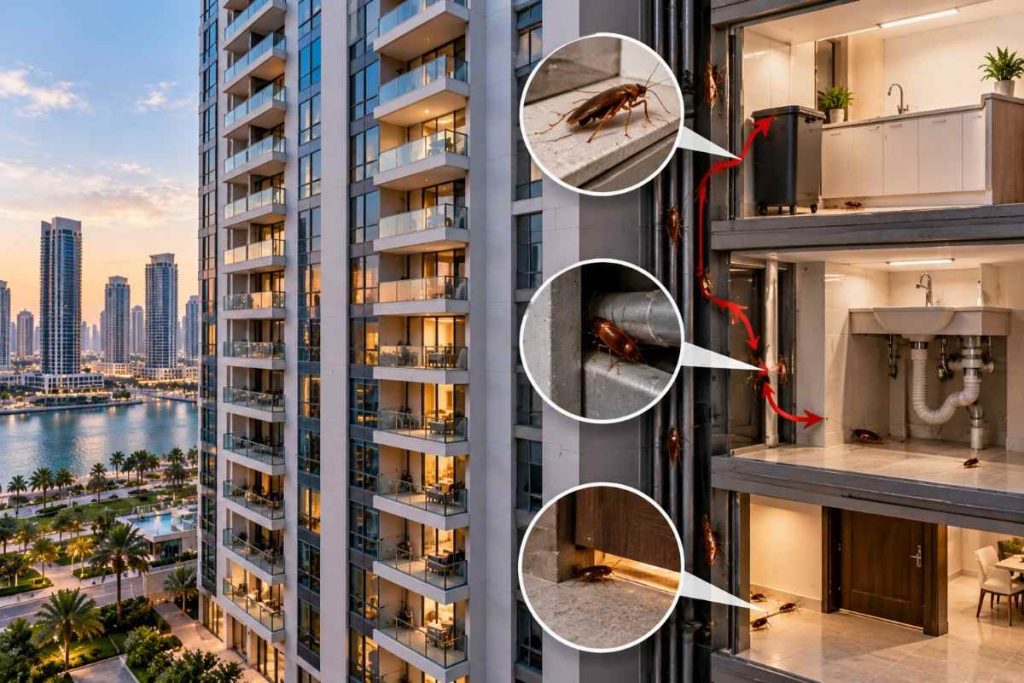
Al Reem Island’s residential environment includes clusters of high-rise buildings and apartment complexes.
That creates an important difference between a cockroach problem in one isolated property and a problem within multi-unit housing.
Research on a 188-unit high-rise apartment building found spatial relationships between cockroach infestations in different apartments. The study also found that building-wide integrated pest management reduced cockroach dispersal between units.
This does not mean every cockroach sighting in an Al Reem apartment comes from another unit. It means the building context should be considered when activity is persistent or recurring.
High-rise living changes the problem-solving context
In an apartment, the source of activity may not be obvious from the room where a cockroach is seen.
A proper assessment may need to consider:
- neighbouring units
- shared building conditions
- plumbing-related pathways
- service areas
- cracks and concealed spaces
- food and moisture sources
Research on German cockroaches in multi-unit housing supports using monitoring and integrated pest management rather than treating every apartment as a completely separate environment.
When building management may need to be involved
If you know that similar cockroach activity is occurring in more than one apartment, or if the problem keeps returning after treatment, it can be useful to inform building or property management.
The reason is simple: some apartment pest problems may involve conditions beyond the individual unit.
Building-level research supports considering the wider environment when managing cockroaches in multi-unit housing.
Before Calling Pest Control What You Can Check Yourself
Before arranging professional help, you can make a few basic observations.
The goal is not to diagnose the infestation yourself. It is to understand the pattern and remove conditions that can support cockroach activity.
Check common food and moisture sources
Cockroaches need access to food, water and shelter. Practical prevention measures include:
- cleaning food spills and crumbs
- storing food in sealed containers
- removing rubbish regularly
- keeping kitchen surfaces clean
- fixing or reporting leaks
- keeping relevant areas dry
- avoiding unnecessary clutter
Penn State Extension recommends sanitation, moisture reduction, sealing cracks and monitoring as part of cockroach prevention and integrated pest management.
Cleanliness should not be treated as proof that a home is either “clean” or “dirty.” Cockroaches can enter buildings for reasons unrelated to poor housekeeping, including access to food, water and suitable shelter.
Look for possible harbourage and entry points
Look carefully around areas where cockroaches could remain hidden, including:
- cracks and crevices
- cabinets
- areas around appliances
- under or around sinks
- bathrooms
- other dark, sheltered spaces
German cockroaches can hide in cracks and narrow openings, making a visual inspection alone imperfect. Penn State notes that trapping or monitoring can sometimes be necessary to determine the extent of an infestation.
When DIY Measures Are No Longer Enough
Professional assessment becomes more reasonable when the problem is persistent, recurring, widespread or difficult to locate.
Consider seeking professional help when:
- sightings continue instead of stopping
- you find egg cases or nymphs
- activity appears in several areas
- you keep seeing cockroaches after attempting basic control
- you cannot identify where the activity is coming from
- the problem may involve more than one apartment
- you need help determining the extent of the infestation
The important point is that professional pest control should not simply mean spraying whatever area contains the visible cockroach.
The problem keeps returning
If cockroaches keep coming back, repeating the same action without reassessing the situation may not address the underlying problem.
Possible factors include:
- remaining food or moisture sources
- concealed harbourage
- untreated areas
- movement within a multi-unit building
- insufficient monitoring
- conditions that continue to support activity
Integrated pest management research has found better cockroach-control outcomes from approaches that combine monitoring, sanitation, building maintenance and targeted pest control rather than relying solely on traditional pesticide application.
Cockroach activity appears in multiple areas
Activity in several areas deserves more attention than an isolated sighting.
For example, repeated activity around both a kitchen and bathroom may justify a closer inspection of possible harbourage and moisture sources.
If activity also appears to involve neighbouring apartments or shared building areas, the problem may need to be considered at a broader level.
What a Professional Cockroach Inspection Should Look At
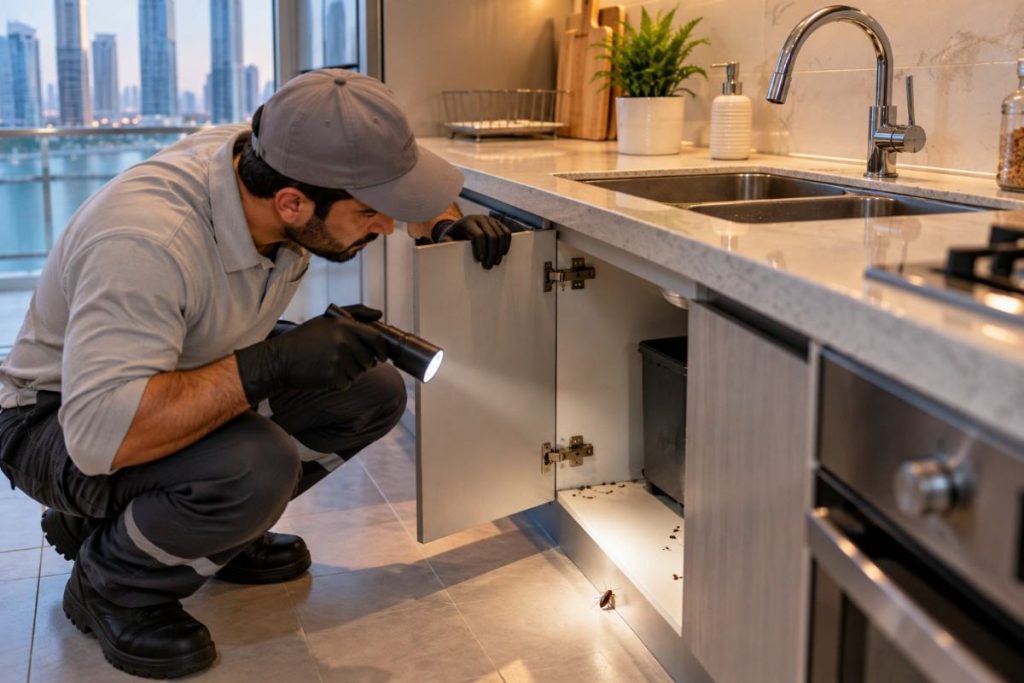
A useful professional inspection is about more than finding the cockroach you happened to see.
It should help establish:
- What pest is present
- Where activity is occurring
- Where cockroaches may be hiding
- What conditions may support the activity
- Whether monitoring is needed
- What treatment and follow-up approach is appropriate
The Abu Dhabi Technical Guideline for Cockroach Pest Management is specifically intended as a reference for cockroach-management best practices in Abu Dhabi. It provides local technical guidance on professional cockroach management. Abu Dhabi Technical Guideline for Cockroach Pest Management (ADG-019-2024)
Identification and assessment of activity
Correct identification matters because cockroach species can behave differently and use different environments.
The assessment should therefore focus on the actual pest and its activity rather than assuming that every cockroach problem is identical.
Finding harbourage and contributing conditions
Inspection should consider locations where cockroaches can remain concealed, together with relevant food, water and structural conditions.
This is particularly important when visible sightings are only occasional.
Monitoring and follow-up
Monitoring can provide information that a quick visual inspection cannot.
Penn State Extension notes that sticky traps can be used strategically to help determine the extent of cockroach activity. Research in multi-unit housing has also used monitoring as part of building-wide IPM.
How Professional Cockroach Control Differs From Simply Spraying
Professional cockroach management is better understood as a management process, not simply an application of pesticide.
Integrated pest management can combine:
- inspection
- monitoring
- sanitation
- building maintenance or repairs
- targeted control
- follow-up
Research in multi-unit housing has found IPM approaches effective in reducing cockroach populations, while building-wide research has also shown benefits for reducing dispersal between units.
This is why a professional assessment can be useful when the source or extent of the problem is unclear.What a Professional Cockroach Inspection Should Look At
If you have reached the point where recurring cockroach activity needs professional assessment, you can learn more about local service options on the Pest Control Al Reem Island page.
What to Do After Professional Treatment
Treatment is not the only part of long-term cockroach management.
Continue paying attention to:
- food storage
- spills and crumbs
- moisture
- leaks
- waste
- cracks and gaps
- clutter and potential harbourage
- new cockroach activity
Monitoring what happens after treatment can also help determine whether activity is actually declining.
The goal is not simply to stop seeing a cockroach for a day. The goal is to address the conditions and activity pattern that allowed the problem to persist.
When the Problem May Need a Building-Level Response
A building-level response becomes more relevant when evidence suggests that cockroach activity extends beyond one apartment.
Examples include:
- several residents reporting similar activity
- recurring activity after treatment
- evidence in shared areas
- suspected movement between units
- conditions that cannot be addressed from inside one apartment
Research in high-rise housing shows why this wider perspective can matter. In the 188-unit study, infestations were spatially correlated within the building, and building-wide IPM reduced dispersal between units.
That does not prove that a particular Al Reem Island building has a building-wide infestation. It simply shows why multi-unit housing should sometimes be assessed as a connected environment rather than as a collection of completely independent apartments.
Frequently Asked Questions
Is seeing one cockroach enough to call pest control?
Not necessarily. One sighting does not provide a universal basis for diagnosing an infestation. Consider the wider pattern, including repeated sightings, physical evidence, activity in multiple areas and whether the problem returns.
How do I know if I have a cockroach infestation?
Repeated sightings, droppings, egg cases, nymphs and continuing activity around likely harbourage areas can indicate that further investigation is warranted. There is no universal numerical threshold that defines an infestation.
Why do cockroaches keep coming back after treatment?
Possible reasons include remaining food or moisture sources, concealed harbourage, untreated areas, inadequate monitoring or activity elsewhere in a multi-unit building. The exact reason needs to be assessed rather than assumed.
Can cockroaches spread between apartments?
Cockroach infestations can have relationships between units in multi-unit housing. A high-rise apartment study found spatial correlations between infestations and found that building-wide IPM reduced dispersal between units.
Can I control cockroaches without professional pest control?
Basic prevention and monitoring can be useful, particularly for understanding and reducing food, water and shelter sources. However, persistent or recurring activity, reproductive evidence or an unclear source can justify professional assessment.
Should I tell building management about cockroaches?
If activity appears to involve multiple apartments, shared areas or a recurring building-related problem, informing building management can be appropriate. Multi-unit research supports considering the wider building environment when infestations persist.
What does professional cockroach control involve?
A professional approach can include identification, inspection, monitoring, targeted treatment and follow-up. Integrated pest management combines pest control with sanitation and building-related measures where appropriate.