
Yes, bed bugs can spread from one apartment to another, especially in multi-unit buildings. They cannot fly or jump, but they are skilled crawlers, and they can move through connected spaces between units. Just as often, they travel a different way entirely: riding along on clothing, bags, furniture, or bedding that someone carries from one apartment to the next.
This is exactly why apartment buildings and shared residential blocks tend to be more vulnerable than standalone houses. Units share walls, utility openings, hallways, and other connected spaces, and sometimes even furniture left behind by previous tenants. If you suspect bed bugs, either in your own apartment or in a neighbor’s unit, the smartest move is to look for physical evidence, tell your building management, and avoid moving items between apartments until the situation is assessed.
Also check our bed bug control in Abu Dhabi
How Do Bed Bugs Spread From One Apartment to Another?
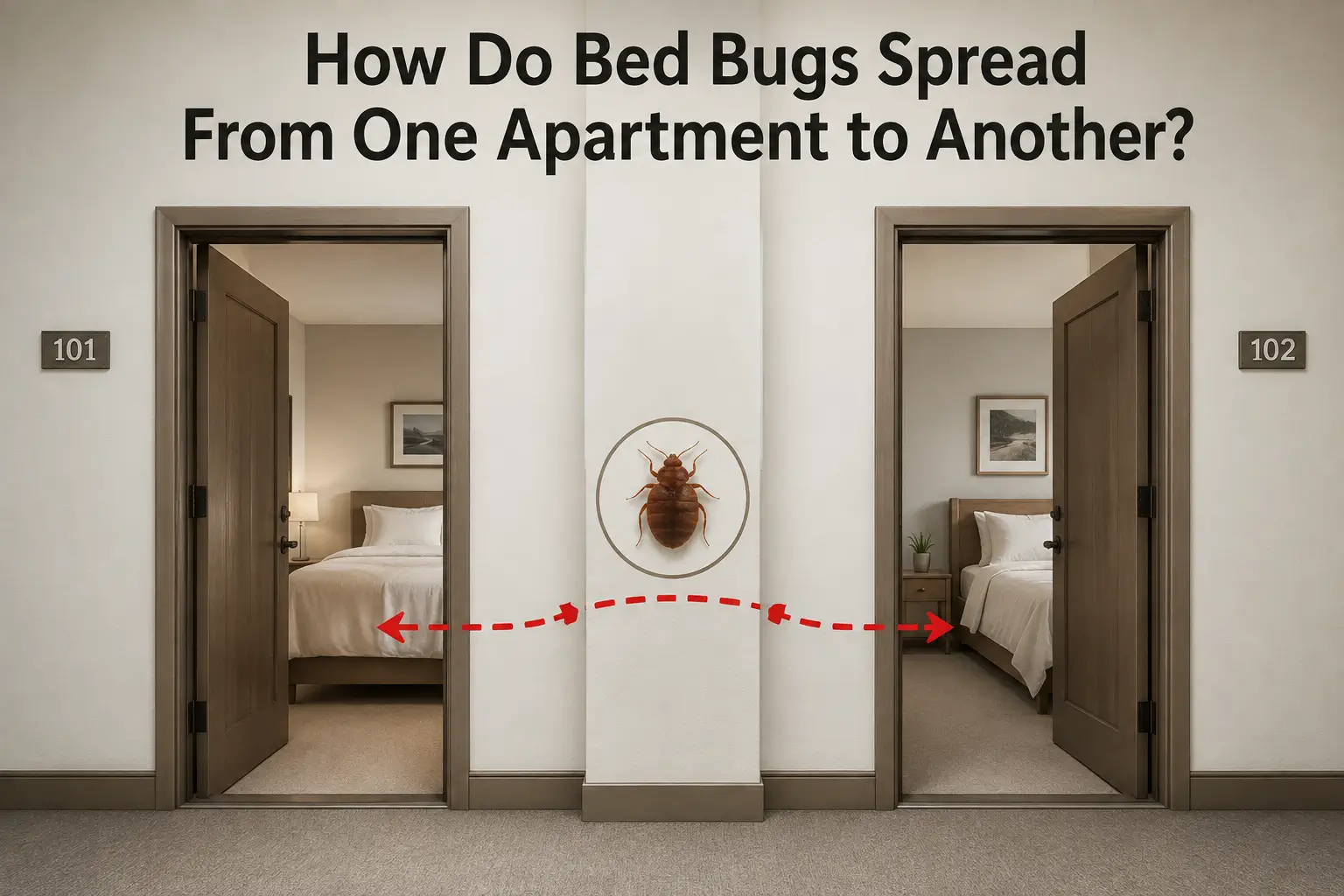
Bed bugs spread between apartments through two main routes: they either crawl through the building itself, or they get carried by people. Understanding both helps you recognize where your own risk is coming from.
Through Cracks and Wall Voids
Bed bugs are flat and narrow, which lets them squeeze through surprisingly small gaps. In older or poorly sealed buildings, cracks around baseboards, loose skirting, and small openings in shared walls can give them a path from one unit’s wall void into another’s.
Through Electrical Outlets and Utility Openings
Openings around electrical outlets, switch plates, pipes, and other wall penetrations can act as gaps between units. Bed bugs can use the space around these fittings to move from one apartment’s wall cavity into a neighboring one. This is different from bed bugs travelling inside electrical wiring itself, which is not how they behave. It is the small physical gap around the fitting, not the wire, that matters.
Through Hallways and Common Areas
In a heavily infested unit, bed bugs may eventually wander into hallways, particularly if they are searching for a new host or hiding spot. From there, they can end up near a neighboring doorway or be carried further by foot traffic. This is more likely once an infestation has grown large rather than in the early stages.
On Clothing, Bags, and Personal Belongings
This is an important way bed bugs move between apartments. A visitor sitting on an infested sofa, a resident picking up a bag from a neighbor’s unit, or even a maintenance worker moving between apartments can unintentionally carry a bed bug on clothing or in a bag.
Through Furniture, Bedding, and Other Items
Moving an infested mattress, sofa, bed frame, or boxes out of an apartment can quickly introduce bed bugs into another room or apartment. This applies whether the item is being thrown out, donated, sold secondhand, or simply moved into another room or apartment in the same building.
Also read > How Many Bed Bug Treatments Are Needed to Get Rid of an Infestation?
Can Bed Bugs Travel Through Walls?
Bed bugs cannot pass through solid wall material such as concrete, brick, or intact drywall. What they can do is use existing gaps: cracks, unsealed joints, wall voids, and the openings around pipes or wiring that pass between units. It helps to separate three things that often get blurred together:
- Crawling through cracks and gaps — bed bugs use existing openings, they do not create new ones by chewing through material.
- Moving around pipes and wiring — the small gaps surrounding these fittings, not the pipes or wires themselves, are the pathway.
- Being carried by people — this does not involve the wall at all and is usually a faster route than crawling.
Bed bugs do not eat through walls, and they cannot tunnel through solid, well-sealed building materials.
How Fast Can Bed Bugs Spread Between Apartments?
There is no fixed timeline for how quickly bed bugs move from one apartment to the next. Spread depends on several factors:
- the size of the existing infestation
- the building’s layout and how many shared openings exist
- how many hiding places are available
- how much access neighboring units have to each other, such as through connecting doors, shared walls, or storage areas
- how quickly the infestation is noticed
- whether any treatment has already been attempted
- whether belongings have been moved between apartments
As a general pattern, movement through connected building spaces, such as cracks and wall voids, tends to be gradual. Hitchhiking on people or belongings works differently and can introduce bed bugs to another apartment much sooner, sometimes in a single trip. They do not move like flying insects that can rapidly cover distance on their own, but an untreated infestation that is left to grow can eventually affect neighboring units through either route.
Can Bed Bugs Spread Upstairs or Downstairs?
Vertical spread is possible, though it is generally less common than spread between apartments on the same floor. It can happen through shared plumbing risers, electrical chases, or other connected structural spaces that run between floors. More often, though, vertical spread happens the same way spread between adjacent units does: through people and belongings. A resident carrying a bag, a piece of furniture, or laundry between an upstairs and downstairs unit can introduce bed bugs just as easily as crawling through a wall void can.
Which Apartments Are Most at Risk?
When an infestation is confirmed in one unit, certain neighboring apartments are generally considered a higher priority for inspection:
- the apartments directly beside the affected unit, sharing a wall
- the units directly above and below, which may share plumbing risers or electrical chases
- units across the hall, especially if residents or visitors move between the two
- apartments connected through shared storage rooms, laundry areas, or other structural connections
Being nearby does not automatically mean a neighboring apartment is infested. Proximity increases the chance that an inspection is worthwhile, but it is not proof of an existing problem.
How Can You Tell If Bed Bugs Are Coming From a Neighboring Apartment?
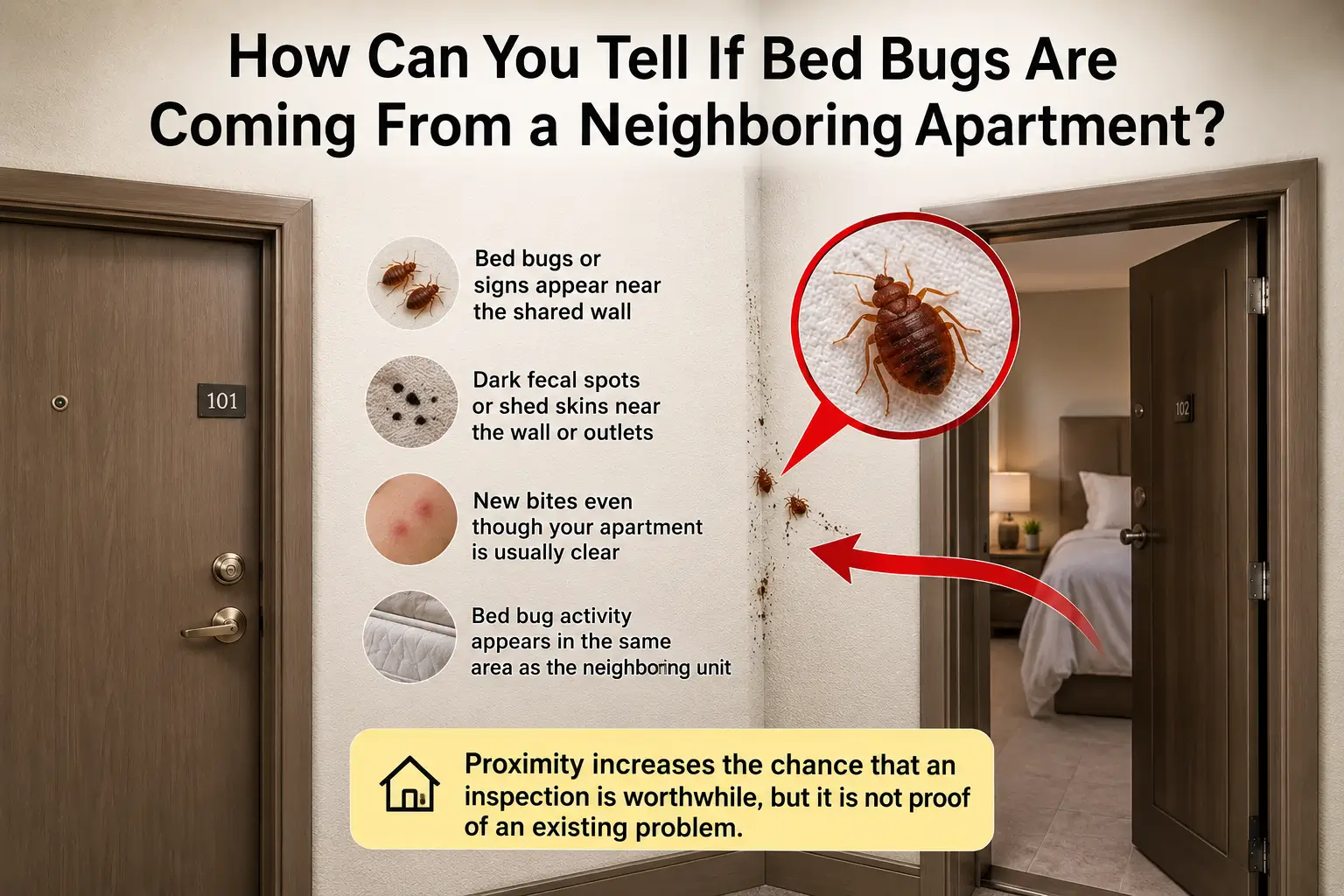
There is rarely a single, definitive sign, but a few patterns make it more likely:
- a neighboring unit has a confirmed infestation, especially one sharing a wall, floor, or ceiling
- signs first appear near a shared wall rather than spreading inward from elsewhere in the apartment
- bed bugs keep returning after treatment despite no new items being brought into the home
- someone recently moved belongings between your apartment and a neighboring one
- the building has a pattern of infestations across multiple units rather than an isolated case
None of these confirm the source on their own, and you usually cannot determine where an infestation originated from bites alone. A professional inspection, sometimes covering more than one unit, is the most reliable way to establish where the problem is coming from.
What Are the Signs of Bed Bugs in an Apartment?
Because bite reactions vary so widely from person to person, and some people do not react at all, physical evidence is a far more reliable indicator than bites alone. Look for:
- live bed bugs, which are small, flat, and reddish-brown
- dark or rust-colored fecal spots on sheets, mattress seams, or furniture
- shed skins left behind as bed bugs grow
- tiny eggs or eggshells in cracks and seams
- small blood spots on bedding
- clusters of activity around mattress seams, bed frames, and headboards
- signs in upholstered furniture, particularly seams and folds
- activity in nearby cracks and crevices, including behind loose baseboards or wallpaper
If you notice any of these signs, or you are getting unexplained bites but cannot find bites-related evidence, an inspection is the next reasonable step rather than assuming based on bites alone.
What Should You Do If Your Neighbor Has Bed Bugs?
- Notify your property manager or landlord as soon as you learn about the situation.
- Ask whether nearby units, including yours, will be inspected as part of the response.
- Inspect your own sleeping and resting areas, focusing on mattress seams, bed frames, and upholstered furniture.
- Avoid bringing used furniture or other belongings from the affected apartment into your own unit.
- Do not move your own belongings into another apartment as a precaution, since this can spread the problem rather than avoid it.
- Limit unnecessary movement of items that may have been exposed, such as bags left near the affected unit.
- Contact a qualified pest control professional if you find any signs in your own apartment.
- If treatment is scheduled in your unit, follow the preparation instructions provided by the pest control company closely, since proper preparation affects how well the treatment works.
Can Treating Only One Apartment Make the Problem Come Back?
Treating a single unit can fail to solve the problem when the infestation extends beyond that apartment. Reinfestation is more likely when:
- neighboring units are also infested but were not treated
- the original source of the infestation was never identified
- some bed bugs remain in areas that were not treated
- belongings are moved between units during or after treatment
- a scheduled follow-up inspection or treatment is skipped
This is why, in multi-unit housing, inspecting surrounding apartments is often part of a thorough response. It does not mean every neighboring unit needs chemical treatment. An inspection is what determines whether treatment is actually necessary in a given apartment, and if so, how extensive it needs to be.
How to Prevent Bed Bugs From Spreading to Another Apartment
- Avoid moving furniture between units, even temporarily.
- Inspect secondhand furniture carefully before bringing it into your apartment.
- Keep any potentially exposed belongings contained and separate from the rest of your items.
- Use sealed bags when transporting items that need to be treated or inspected.
- Reduce clutter around beds and seating areas, since clutter creates extra hiding spots.
- Inspect luggage after travel, before bringing it into your bedroom.
- When using a shared laundry facility, carry potentially exposed clothing in sealed bags, and move dried items directly into a clean bag or container rather than setting them on shared surfaces.
- Seal obvious cracks and gaps where practical, particularly around baseboards and utility penetrations.
- Report suspected infestations quickly rather than waiting to see if the problem goes away.
- Cooperate with building management and pest control professionals when inspections or treatments are scheduled.
What Should You NOT Do If You Find Bed Bugs?
- Do not move to another apartment and take your existing belongings with you.
- Do not throw furniture or mattresses into hallways or shared areas.
- Do not move potentially infested items from room to room within your unit.
- Do not rely only on DIY sprays as a complete solution.
- Do not assume a clean, tidy apartment cannot have bed bugs. Cleanliness does not prevent infestations.
- Do not ignore the risk simply because a neighboring apartment is the source rather than your own.
- Do not rely on bites alone to conclude that bed bugs are present or absent.
When Should You Call a Professional Bed Bug Control Company?
Professional inspection becomes particularly important when:
- you find live bed bugs in your apartment
- evidence continues to appear after you clean the area
- multiple rooms in your apartment are affected
- a neighboring apartment has a confirmed infestation
- the problem keeps returning after previous treatment attempts
- DIY methods have not resolved the issue
- the building has more than one affected unit
At this stage, a professional inspection can identify hiding areas that are easy to miss and help determine the right treatment approach for the specific situation, since accurately locating an infestation is usually the difference between a treatment that works and one that needs to be repeated.
Bed Bug Treatment for Apartments in Abu Dhabi
Apartment living in Abu Dhabi comes with its own set of considerations when it comes to bed bugs. Buildings often include shared corridors and a steady flow of residents, tenants, and visitors, which creates more opportunities for bed bugs to move between units compared to a standalone villa.
Because of this, apartment cases often benefit from a coordinated approach rather than treating a single unit in isolation. This generally starts with a free, no-obligation inspection to assess the extent of the problem, followed by a written quote before any treatment begins. For severe bed bug cases, residents are typically asked to vacate the treated apartment for a few hours while the treatment takes place, and a follow-up visit is usually included to catch any bed bugs that hatch from eggs missed during the first treatment. American Bite Pest Control offers this kind of inspection-first bed bug control service across Abu Dhabi, including Mussafah, MBZ City, Khalifa City, and surrounding areas.
Frequently Asked Questions
Can bed bugs spread from one apartment to another?
Yes. They can crawl through cracks, gaps, and shared wall openings in connected buildings, and they can also be carried between apartments on clothing, bags, and furniture.
Can bed bugs travel through walls?
They cannot pass through solid, intact wall material. They can use existing cracks, gaps, and openings around pipes or wiring to move between connected spaces.
Can bed bugs come from a neighbor’s apartment?
Yes, this is a common source of new infestations in multi-unit buildings, particularly through shared walls, hallway traffic, or belongings that move between units.
Can bed bugs travel through electrical outlets?
They can use the small gaps around outlets and switch plates as a pathway between units, but they do not travel inside the wiring itself.
Can bed bugs travel between floors?
It is possible, particularly through shared plumbing risers, wall voids, or belongings that are moved between floors, though it is generally less common than spread between adjacent units on the same floor.
Should neighboring apartments be inspected for bed bugs?
In many cases, yes, especially units that share a wall or are directly above or below the affected apartment. An inspection determines whether treatment is actually needed, rather than assuming every nearby unit is infested.
Final Takeaway
Bed bugs can move between apartments, but the situation is rarely as fast or unstoppable as it might feel in the moment. Early detection, prompt reporting to your landlord or property manager, inspection of surrounding units where appropriate, careful handling of furniture and belongings, and professional treatment together go a long way toward reducing the risk of a building-wide infestation.
If you live in an apartment in Abu Dhabi and suspect bed bugs, whether in your own unit or a neighboring one, a professional inspection is the clearest way to understand what is actually happening and what to do next. American Bite Pest Control can help you assess the situation and put together a treatment plan suited to your building.