
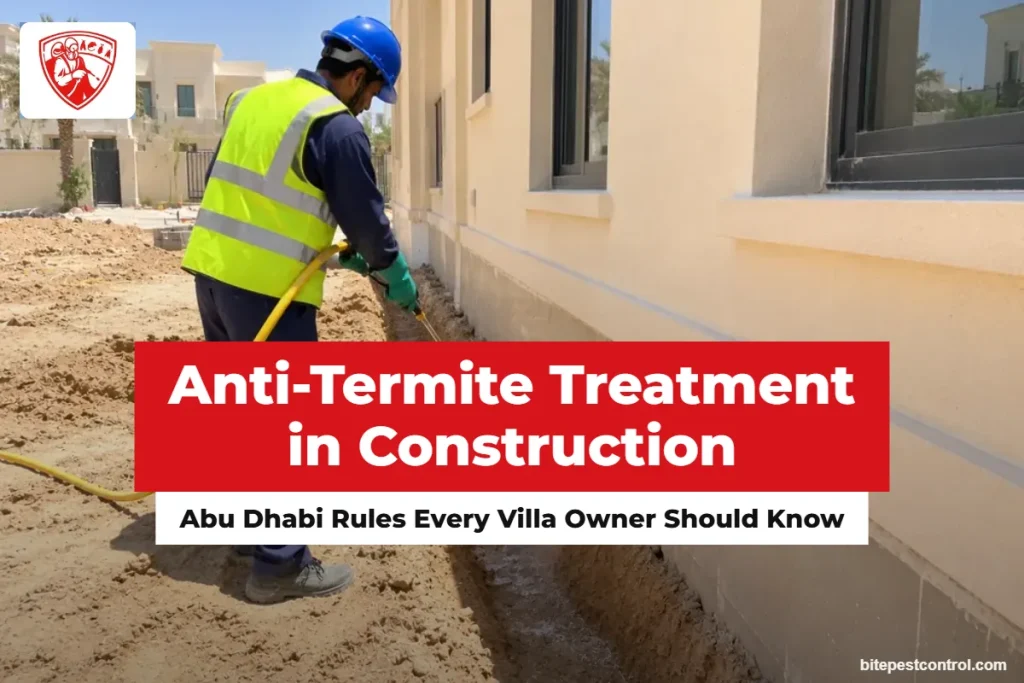
The plot is levelled, the foundation pits are dug, and your contractor says the blinding concrete arrives on Sunday. Somewhere in the paperwork there is a line for anti-termite treatment, and most villa owners sign it without a second look. That is a missed chance. Abu Dhabi has a written guideline that spells out how this work must be done, step by step. This article explains those rules in plain words, so you can check that your pre-construction termite treatment in Abu Dhabi is done properly before the soil is covered for good.
Is Anti-Termite Treatment Required When Building in Abu Dhabi?
The rules come from the Abu Dhabi Guideline for Public Health Pest Control Services: Termite Management, known as ADG 24/2024. Its second edition was approved in 2024. The Abu Dhabi Quality and Conformity Council prepared it at the request of the Abu Dhabi Public Health Centre (ADPHC), with input from the Ministry of Climate Change and Environment (MOCCAE), the municipalities and UAE University. If you want to know the official rules for anti-termite treatment in construction here, this is the document that matters.
The guideline calls pre-construction work a preventive treatment carried out at the foundation stage. It applies when there is a risk of termites, a legal requirement, or a client requirement. In practice, your consultant’s specification or your own decision is usually what brings it in. The guideline does not say every villa must be treated, so be careful with anyone who claims otherwise without showing you the clause.
Who does the work also matters. Since May 2024, ADPHC oversees permits for all pest control activity in the emirate, a role it took over from Tadweer. The company treating your soil should hold that permit.
The wider region is heading the same way. In October 2024, Bahrain made termite treatment before construction a condition for building approval, with a certificate submitted to the municipality. Abu Dhabi has not gone that far, but its guideline already sets the standard a good contractor should meet.
Five Rules From ADG 24/2024 Every Villa Owner Should Know
1. It is done once, at the foundation stage
Pre-construction treatment is a one-time job that moves with the build. The guideline expects it to protect the building for at least 5 to 10 years. After that, a preventive treatment of the finished building may be needed. If someone offers to “do it later”, they are offering a different service, not the same one at a different time.
2. Liquid termiticide is the mandatory method
The guideline lists four methods. A liquid termiticide spray is mandatory. Bait stations, anti-termite blankets and stainless steel mesh are optional extras that can be added if you or your consultant want them, but none of them replaces the spray.
3. Only registered, non-repellent products
Every termiticide used must be valid, registered and approved by MOCCAE. Since a 2018 ministerial decree, all pesticides in the UAE must be registered with the ministry before they can be imported or sold.
The guideline also says repellent products are not recommended. A repellent chemical makes termites turn away and look for a gap somewhere else. A non-repellent one, such as imidacloprid, is slow acting and gets passed from termite to termite inside the colony. Ask for the product name, and ask whether it is non-repellent.
4. Treated soil must be covered within 24 hours
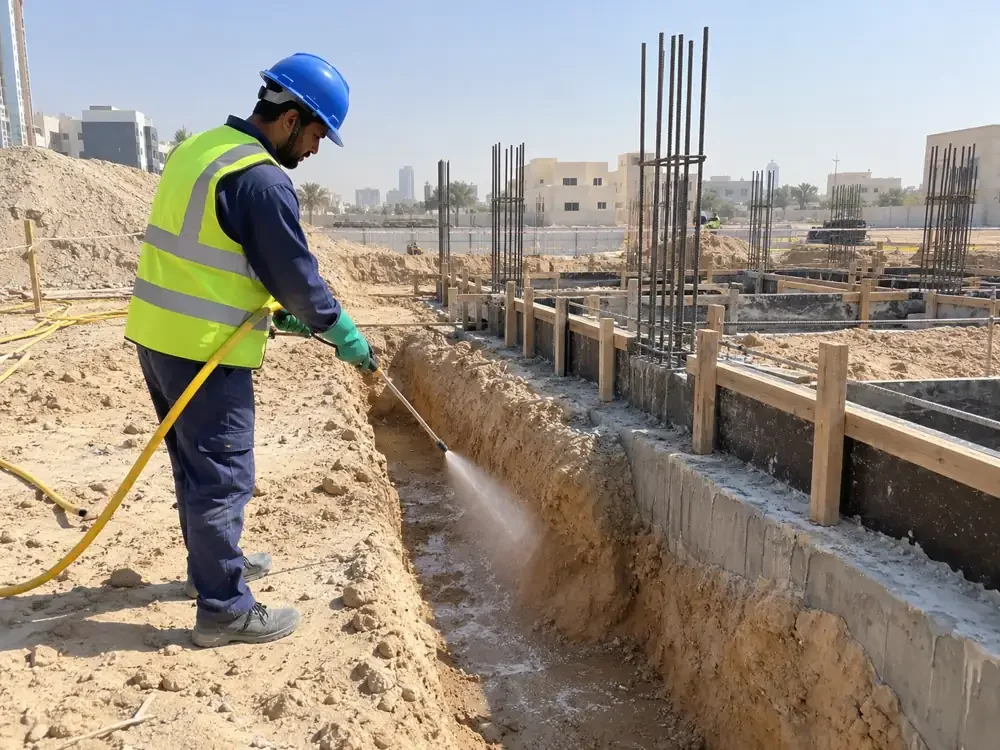
People often ask when anti-termite treatment should be done before the foundation PCC. The answer is right before it. Under footings, pile caps, tie beams and water tanks, the soil is levelled, compacted and sprayed, and the blinding concrete must be cast within 24 hours. Until then, the treated soil has to be protected from rain and disturbance. The guideline also says not to spray outdoors on windy or rainy days. So the treatment visit and the concrete pour need to be planned together, not booked separately.
5. Your approval comes first
Before any spraying, the company should get your approval, or your consultant’s, for the product and the drawings. It should also ask for your casting timetable and send you a work plan with dates. If a technician arrives and starts spraying without any of this, treat it as a warning sign.
Which Parts of the Site Are Treated
The guideline goes through the building one element at a time. Here is a simplified view of what it asks for.
| Part of the build | When it is treated | Key rule |
|---|---|---|
| Under footings, pile caps and tie beams | Before blinding | Blinding cast within 24 hours |
| Sides of foundations and backfill | As backfill reaches each 1 metre | Small trench along the sides, backfilled within 24 hours |
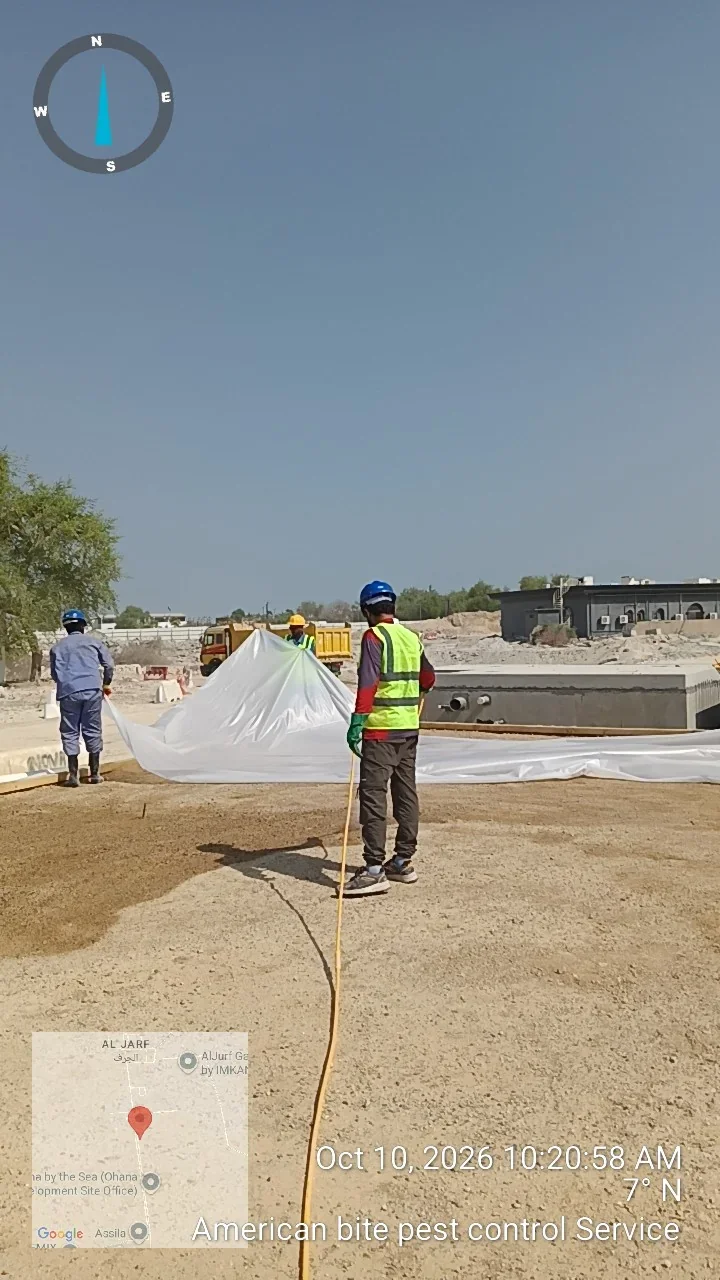
| Slab on grade with polythene | After the steel is fixed, before casting | Polythene punched every 1 metre, slab cast within 24 hours |
| Pits and underground water tanks | Under, around and above | Treated in stages, like foundations |
| Pipes and conduits through slab or walls | Before the pipe is fixed | Hole sprayed, 2 hour wait, mesh advised |
| Building perimeter | End of the build | Trench about 30 cm wide and 60 cm deep, soaked at low pressure |
That is a lot of visits on a schedule that keeps moving. Our stage-by-stage soil treatment page shows how each visit is booked with your site engineer so concrete work does not wait.
Safety on Site During the Work
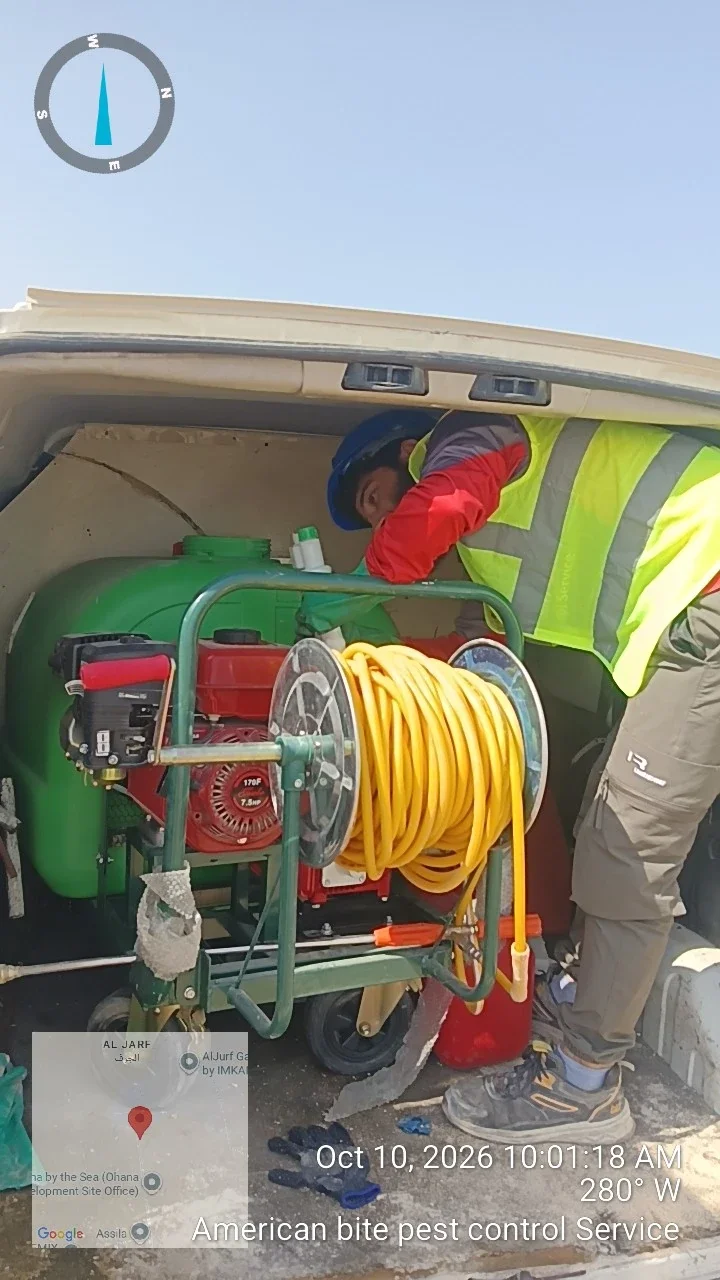
Termiticides are pesticides, so the guideline treats the area like a work zone. It is marked off with warning tape or cones, and anyone not involved is kept away until the soil has soaked up the solution, usually about 2 hours depending on the soil. Technicians wear full protective gear, follow the product label and safety data sheet, and take empty containers away as hazardous waste. If you visit on treatment day, keep children and other workers clear of the marked area. Our supervised team follows these steps on every visit.
The Records You Should Get
Once the slab is poured, nobody will ever see the treatment again. Paper is your only proof. Section 1.7 of the guideline lists what the company must record for each project. Ask for a copy of:
- The product trade name, dilution rate and application rate
- The area treated, the quantity of product used and the volume of solution applied
- The supplier’s official invoice for the product
- The product label and safety data sheet
- The date and time of each visit, and the names of the staff who did it
- Your approval and your sign-off on each service report
Keep these with your handover file. If you ever sell or rent the villa, they show the home was protected from day one. You can also check our licence and certifications before you book anything.
Questions to Ask Before You Sign
A few minutes of questions now can save you a lot of trouble later:
- Who is paying? Check whether the treatment sits in the main contractor’s bill of quantities or is left to you.
- Who calls before each pour? Agree who tells the pest control company that a pit or slab is ready.
- Which product? Get the name, confirm it is MOCCAE registered, and ask if it is non-repellent.
- How is the price worked out? Most quotes are per square metre of plinth area, so compare quotes that cover the same stages.
- What does the warranty cover? Ask how long it lasts, what inspections are included and what could cancel it.
If you are still deciding whether the cost is worth it, our guide on why pre-construction termite treatment is important sets out the honest pros and cons.
What If the Foundations Are Already Poured?
It happens more than people admit, and it is not the end of the story. Treat whatever is still open: backfill, tie beams, the slab on grade, pipe entries and the perimeter. Partial treatment is better than none. For a finished building, the guideline describes post-construction methods such as drilling and injecting along walls and floors, which our termite control service covers.
Frequently Asked Questions
Is anti-termite treatment mandatory in Abu Dhabi?
ADG 24/2024 treats it as preventive work carried out when there is a termite risk, a legal requirement or a client requirement. Many consultant specifications include it, so check yours.
How long does pre-construction termite treatment last?
The guideline expects protection for at least 5 to 10 years. After that, a preventive treatment of the finished building may be needed.
What happens if it rains after the soil is sprayed?
Treated soil must be protected from rain and disturbance until the blinding or slab is cast, and spraying should not be done on rainy or windy days. If rain reaches the soil before it is covered, ask the company to check and treat that area again.
Who should keep the treatment records?
The pest control company must keep them for each project. Ask for your own copies too and file them with your villa handover documents.
Build It Right From the Ground Up
Most of the rules for anti-termite treatment in construction come down to two things: timing and paperwork. Get both right and your villa starts life with a proper soil barrier under it, and a file that proves it.
American Bite Pest Control treats new villas across Abu Dhabi, including Khalifa City, MBZ City and Al Shawamekh. Send your plot location, plinth area and construction stage on WhatsApp to +971 56 258 2461, or see how our pre-construction termite treatment works from first visit to final certificate.