
A one-off pest treatment can resolve what’s currently visible, but it doesn’t necessarily stop pests from returning. Once a technician leaves, the conditions that allowed the activity in the first place (a gap in the wall, a moisture source, inconsistent sanitation) are often still there.
An Annual Maintenance Contract (AMC) takes a different approach. Instead of a single visit triggered by a pest sighting, it sets up a planned pest-management programme built around scheduled inspections, preventive measures, ongoing monitoring, and treatment when it’s actually needed. The main benefits include consistent monitoring, earlier detection, more predictable costs, less disruption to daily operations, reduced risk of recurring infestations, and a documented record a business can rely on. The sections below cover what a pest control AMC actually involves and where it tends to make the biggest difference.
What Is a Pest Control Annual Maintenance Contract?
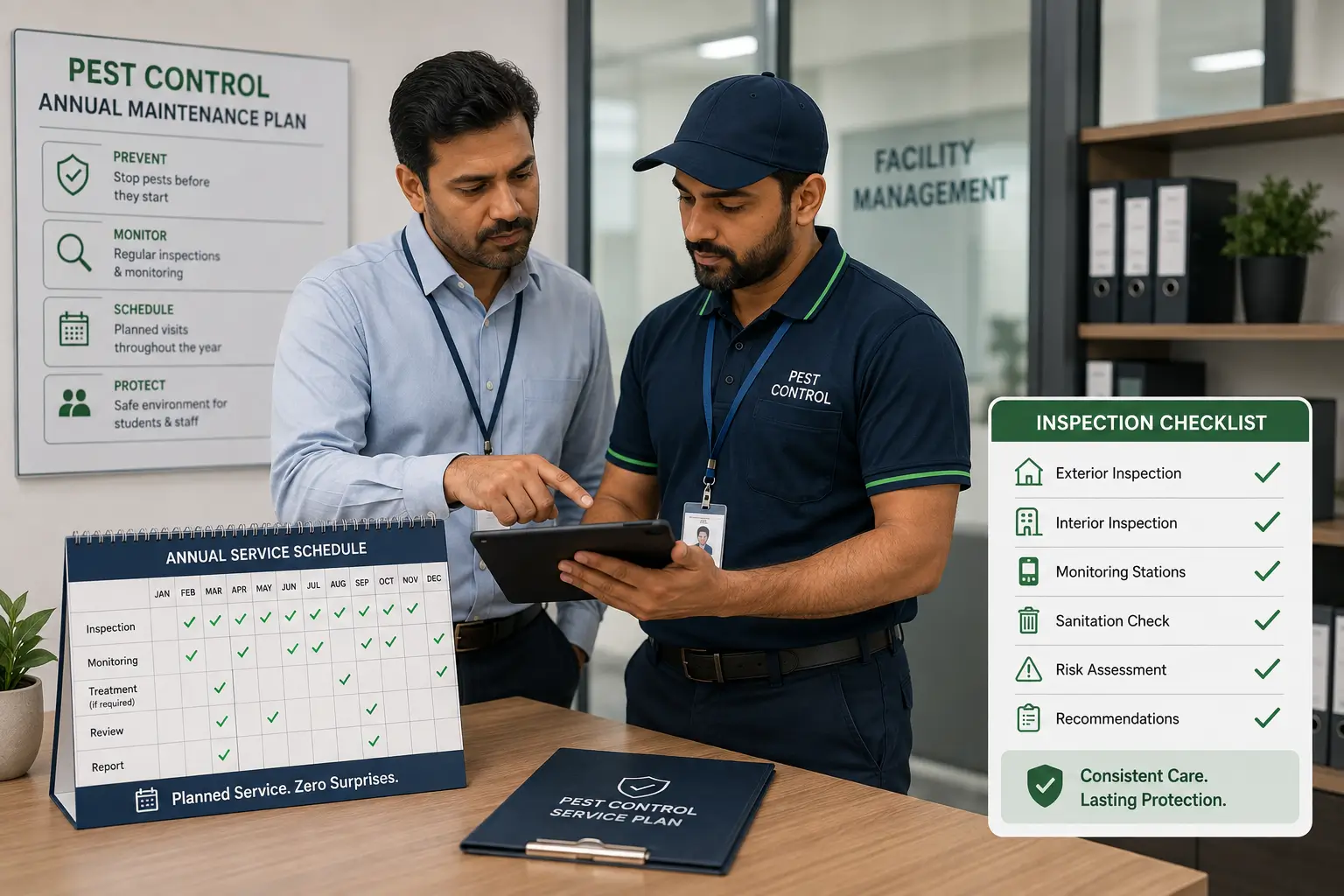
An AMC is an annual agreement between a property or facility and a pest control provider that sets out a pre-planned service schedule rather than one-off, as-needed visits. It typically includes routine inspections at agreed intervals, preventive pest management recommendations, ongoing monitoring, treatment when pest activity is identified, follow-up visits to confirm results, and service documentation.
It’s worth being clear about what an AMC is not. A properly run AMC isn’t a guarantee of monthly chemical treatment regardless of findings. A professional programme is based on inspection and risk, applying treatment only where and when it’s actually warranted, not on a fixed spray schedule that ignores what’s found on site.
10 Key Benefits of a Pest Control AMC
1. Prevents Pest Problems Before They Become Serious
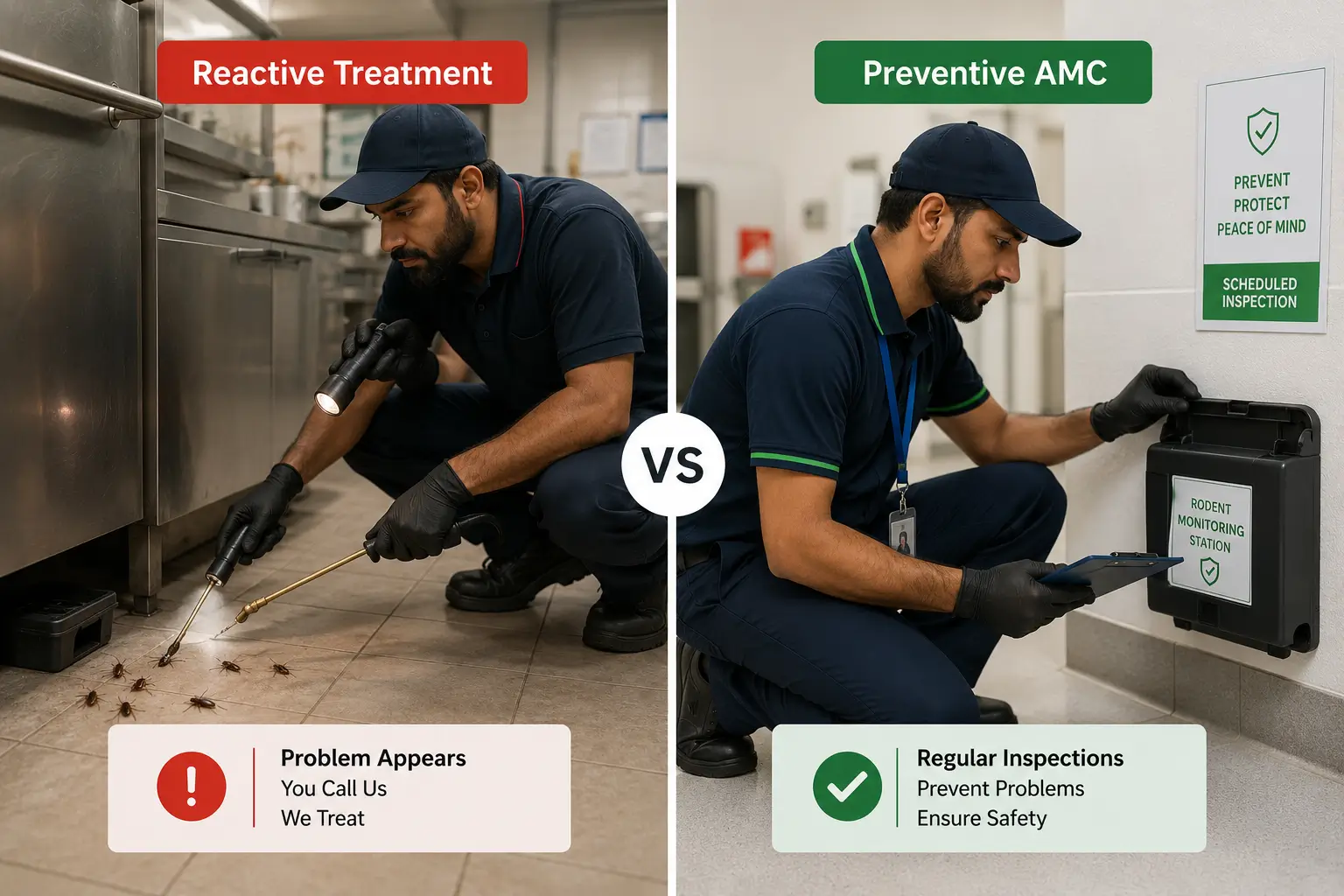
The core difference between reactive and preventive pest control comes down to timing. A reactive approach looks like this: a pest is seen, a technician is called, the infestation is treated. A preventive approach starts before anything is visible: inspect, identify risk factors, monitor, and intervene early if conditions change. Catching a problem at the risk-factor stage can be far less disruptive than dealing with an established infestation.
2. Helps Detect Pest Activity Early
Regular visits give a trained technician the chance to spot early warning signs that facility staff might miss during normal operations, such as droppings, gnaw marks, egg cases, ant trails, harbourage points, damaged packaging, entry points, and moisture-related conditions.
3. Reduces the Risk of Recurring Infestations
Pest problems that keep coming back usually have an underlying cause: a structural gap, an accessible food source, inconsistent waste management, moisture, drainage issues, landscaping conditions, or storage practices. A single treatment addresses the pest that was present at the time, but it doesn’t necessarily fix the condition that let it establish itself. An AMC creates repeated opportunities to identify and correct those conditions, rather than treating the same symptom over and over.
4. Provides Consistent Pest Monitoring
Scheduled visits build a continuous picture of pest activity over time rather than a series of disconnected snapshots, typically through monitoring stations, defined inspection points, and tracked activity trends reviewed at follow-up visits. This ongoing picture is part of what’s known as Integrated Pest Management (IPM), an approach that combines inspection, prevention, monitoring, and targeted treatment rather than relying on treatment alone.
5. Helps Make Costs More Predictable
One-off emergency treatment tends to come with unpredictable expense, especially if a problem has already spread by the time it’s addressed. It wouldn’t be accurate to claim an AMC is always cheaper than one-off treatment, but a planned AMC can make pest-management costs more predictable and may reduce the likelihood of expensive emergency interventions.
6. Minimizes Business or Operational Disruption
For businesses like schools, restaurants, hotels, offices, warehouses, and retail stores, disruption is a genuine operational concern, not just a convenience issue. Planned service under an AMC can be scheduled around working hours, holidays, weekends, delivery windows, and peak business periods, which is much harder to arrange when a technician is being called in reactively.
7. Supports Hygiene and Facility Management
Pest control works alongside, not instead of, cleaning, sanitation, waste management, food storage practices, drainage, and general building maintenance. An AMC gives a facility repeated opportunities to identify conditions the facilities team needs to correct, such as a recurring moisture issue or a gap that keeps reopening. Pest control doesn’t replace good hygiene practices.
8. Creates a Record of Pest Management Activities
Each visit under an AMC can generate inspection findings, treatment records, monitoring results, and recommendations, building a history rather than a single isolated report. This is particularly valuable for businesses with internal facility-management procedures, audits, or compliance documentation requirements.
9. Can Provide a Defined Process for Additional Support
When pest activity appears between scheduled visits, an AMC can include a defined process for requesting additional assistance, depending on the terms of the specific contract. The exact response process, and whether it’s included at no extra cost, varies by provider and contract, so this is worth confirming directly rather than assuming it’s automatically included.
10. Provides a Structured Long-Term Pest Management Plan
Put together, an AMC is more than “a technician visits every month.” It’s a structured cycle of inspection, prevention, monitoring, treatment where needed, follow-up, and documentation, repeated consistently over the course of a year rather than triggered only by a visible problem.
Also Read > How Abu Dhabi’s Climate Affects Pest Treatments
How a Pest Control AMC Works
Initial inspection. The programme typically starts with an inspection covering the building’s overall condition, pest history, food areas, storage, waste management, moisture sources, entry points, and landscaping.
Risk assessment and treatment plan. Findings from the initial inspection are used to identify priority areas and determine what level of intervention, if any, is appropriate for each part of the property.
Scheduled visits. Routine visits follow an agreed schedule, generally involving inspection of the areas identified as higher risk along with a general check of the rest of the property.
Monitoring and treatment. Treatment is applied only where findings support it, rather than as a routine step at every visit regardless of activity.
Reporting and recommendations. Findings from each visit are documented, along with any recommendations for the facilities team, such as sealing a gap or addressing a moisture source.
Annual review. Pest activity and conditions are reviewed periodically so the programme can be adjusted if the property’s risk factors change, for example after renovation work or a change in how a space is used.
What Should Be Included in a Pest Control AMC?
At a minimum, a well-structured AMC should cover:
- An initial inspection
- Scheduled pest inspections throughout the year
- Ongoing pest monitoring
- Preventive recommendations
- Targeted treatment when activity is identified
- Follow-up visits
- Service reports after each visit
- Treatment records
- Recommendations for facility staff
- Clearly defined service areas
- A defined contact or response procedure
- A periodic programme review
The exact services included vary by provider, property type, pest risk, and contract terms. Before signing an AMC, make sure the contract clearly states what’s included, how often visits occur, what happens between scheduled visits, and which services incur additional charges.
Which Businesses Benefit Most From a Pest Control AMC?
Schools and educational facilities benefit from regular monitoring across classrooms, kitchens, cafeterias, storage rooms, washrooms, and outdoor areas, where continuous occupancy by children makes early detection particularly important.
Restaurants and commercial kitchens deal with food, moisture, and waste daily, which makes consistent preventive pest management especially relevant given the sanitation standards these businesses need to maintain.
Hotels have guest rooms, kitchens, waste areas, storage, and common areas that all require ongoing monitoring, often across a much larger footprint than a single-unit property.
Warehouses typically involve large storage spaces, loading bays, packaging materials, and extensive perimeter access points, all of which can create pest risk if left unchecked.
Retail stores handling food products, storage areas, frequent deliveries, and customer-facing environments may need consistent monitoring to protect both stock and reputation.
Offices and commercial buildings still have common areas, kitchens, storage rooms, and waste facilities that benefit from scheduled inspection, even without the food-service intensity of a restaurant.
For commercial and institutional properties in Abu Dhabi, ongoing monitoring can be particularly useful where facilities have food-service areas, landscaping, high occupancy, or other conditions that create recurring pest risk.
What Can Happen When Pest Control Is Only Reactive?
Relying entirely on one-off, as-needed treatment carries some practical downsides worth weighing against the cost of an AMC:
- Problems can go unnoticed between treatments, since there’s no scheduled check to catch early signs
- The underlying causes of recurring activity often remain unresolved, since a reactive visit typically addresses the immediate pest rather than the condition that let it in
- Emergency callouts may become necessary once activity has already spread
- Pest activity can move into adjacent areas before it’s noticed
- Facilities teams have less historical information to work from when problems recur
- Maintenance issues, such as a moisture source or structural gap, may go unidentified for longer
- Treatment stays reactive by design, addressing what’s visible rather than preventing what’s likely
None of this means one-off treatment is never appropriate. It simply means a property relying only on reactive visits is trading some predictability and early detection for lower ongoing commitment.
Annual Pest Control AMC vs One-Time Treatment
| One-Time Treatment | Annual Maintenance Contract |
|---|---|
| Reactive | Preventive |
| Usually triggered by visible activity | Scheduled inspections regardless of visible activity |
| Focuses on the immediate problem | Focuses on ongoing risk |
| Less predictable service | Planned service schedule |
| Limited historical tracking | Ongoing documentation |
| May require emergency response later | Designed to identify issues earlier |
One-time treatment still has a genuine place, particularly for isolated infestations at properties with low ongoing risk. An AMC tends to be more appropriate where a property has recurring pest pressure, food operations, high occupancy, or facility-management requirements that call for continuous monitoring rather than occasional intervention.
How to Choose the Right Pest Control AMC
Before signing a contract, it’s worth checking for:
- Appropriate licensing for commercial or institutional pest control
- Experience with your specific property type
- A clearly defined scope of work
- A defined service frequency
- Inspection and monitoring included as standard, not as an add-on
- A clear explanation of treatment procedures
- Documentation and reporting after each visit
- A defined follow-up process
- Clear terms for emergency or additional-service requests
- Any contract exclusions
- Transparent pricing
- Cancellation and renewal terms
Reviewing these points before signing avoids surprises later, particularly around what’s actually included versus what counts as an extra service.
Need a structured pest-management plan for your property? Explore our pest control AMC services in Abu Dhabi or get in touch to discuss your site’s specific requirements.
Is a Pest Control AMC Worth It?
For properties with recurring pest risk, food operations, large premises, high occupancy, or facility-management requirements that call for documented, ongoing service, an AMC can offer more consistency and predictability than relying entirely on one-off treatments. Not every property needs one, though. A smaller, low-risk site with no history of pest activity may be adequately served by occasional inspection rather than a full annual programme, and it’s reasonable to discuss which approach fits a given property with a provider before committing.
Frequently Asked Questions
What is an AMC in pest control?
An AMC, or Annual Maintenance Contract, is an agreement between a property and a pest control provider covering a planned schedule of inspections, monitoring, and treatment over a year, rather than isolated one-off visits.
What does a pest control AMC include?
This varies by provider and contract, but typically includes an initial inspection, scheduled visits, ongoing monitoring, targeted treatment when needed, follow-up, and service documentation.
Is an annual pest control contract better than one-time treatment?
It depends on the property. An AMC generally suits properties with ongoing pest risk or facility-management needs, while one-time treatment can be appropriate for isolated, low-risk situations.
How often does a pest control AMC include service visits?
Frequency varies by contract and is usually set based on the property’s size, pest history, and risk factors rather than a single fixed interval that applies to every site.
Does an AMC guarantee that pests will never appear?
No. An AMC is designed to reduce risk and catch problems early through regular inspection and monitoring, but no pest control programme can guarantee that pest activity will never occur.
Can an AMC help prevent recurring infestations?
Yes, by giving a provider repeated opportunities to identify and address the underlying conditions, such as entry points or moisture sources, that often cause pests to return after a single treatment.
Are emergency visits included in a pest control AMC?
This depends on the specific contract. Some AMCs include a defined process for requesting additional support between scheduled visits; others treat this as a separate service. It’s worth confirming this directly with the provider.
Conclusion
An AMC shifts pest control from a series of reactive treatments into a planned facility-management programme built around early detection, ongoing monitoring, prevention, more predictable costs, documentation, and reduced disruption to daily operations.